


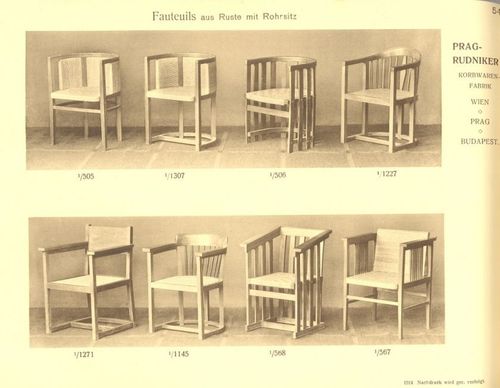
Prag-Rudniker Korbwaren-Fabrication The "Prag-Rudniker Korbwaren-Fabrication" (Prague-Rudnik Wickerware Manufacturing) originated in 1877 in Rudnik (Galicia), where Ferdinand Ernst Count Hompesch founded a school for basket weaving. The distribution of the products was entrusted to the Prague merchants Karl and Josef Kraus. Karl and Josef Kraus eventually founded the "Prag-Rudniker Korbwaren-Fabrication," which was entered into the commercial register in 1886. The headquarters were initially located in Prague but were relocated to Vienna in 1910—though a branch on Vienna's Mariahilferstraße had already existed there since the company's inception. Prag-Rudniker rapidly grew into a major trading enterprise, boasting that it was the "continent's largest wickerware company." The business employed around 2,500 people and operated factories in Budapest, Prague, Rudnik, and Vienna. Furthermore, the company maintained branches in Germany, France, England, the Middle East, and the USA, establishing a global presence. While Prag-Rudniker initially modeled its production heavily on English and American examples, the furniture manufacturer decided at the turn of the century to become the first company in the wickerware sector to produce series models designed by artists—a move that mirrored the approach taken a few years earlier by the Gebrüder Thonet and J. & J. Kohn manufactories in the field of bentwood furniture. Rudniker’s innovative wicker furniture led to a complete re-evaluation of such pieces; they were no longer merely anonymous utilitarian objects but were instead featured in art journals and showcased in exhibitions. Hans Vollmer (1879–1946), a student of Josef Hoffmann, was employed by the company as a key designer starting in 1901; he introduced square and cubic forms into wicker furniture design. In addition to willow rods, Peddigrohr (also known as rattan) was used—a material derived from palms. The frame structure was crafted from native elm wood, a timber prized for its exceptional hardness and elasticity. Around 1900, the company launched a new product line combining wood with woven sections. Inspiration for this came once again from the Anglo-Saxon world, giving rise to a wide variety of chair designs; for instance, one of the rocking chairs is reminiscent of a model by the American artist Gustav Stickley (1858–1942). When Vollmer set up his own architectural practice in 1905, Wilhelm Schmidt (1880–after 1928) succeeded him as Prag-Rudniker’s chief designer, having been appointed to a "leading position" in 1903: "...the majority of the company's charming and well-made furniture was designed by Schmidt. These pieces are by no means composed solely of wickerwork; the finer items, in particular, involve a significant amount of traditional joinery." Schmidt, who had also been with the company since 1901, had—like Vollmer—trained under Josef Hoffmann. It is therefore unsurprising that geometric forms played a significant role in his work as well. Alongside Vollmer and Schmidt, Koloman Moser ranks among the most important designers associated with Prag-Rudniker. These include several chair models featuring basic geometric shapes and checkerboard-patterned woven elements; they were part of the furnishings at the 1903 Klimt exhibition at the Secession. Also on display there was the black-and-white armchair model used at the Purkersdorf Sanatorium—a piece likewise attributed to Kolo Moser in collaboration with Josef Hoffmann. In this design, the woven element was restricted to the seat itself. It was evidently a custom-made piece that was not included in the company's mass-production line. Prag-Rudniker furniture frequently served as design elements in exhibition spaces. Models without textile upholstery were conceived as "veranda and foyer furniture," while upholstered seating was intended for "reception rooms and conversation areas." These were often displayed on rugs that were also part of the company's product range. The upholstery fabrics generally came from the Viennese firm Backhausen & Söhne. In addition to private customers, the company's main clients for its furniture range—which included medical daybeds, rocking chairs, hooded beach chairs, stove screens, wastepaper and laundry baskets, and children's furniture—were hotels, restaurants, and sanatoriums. Subsequently, Prag-Rudniker expanded its range to include wooden furniture without woven elements (some finished in white lacquer) as well as specialty items such as wooden furniture strung with raffia cord, wall paneling made of woven splints, and garden tents.
In the company catalog published around 1910, the firm highlighted "novelties executed according to designs by leading Viennese artists."In addition to Adolf Holub (1882–?), Joseph Urban (1872–1933), and Otto Prutscher (1880–1949), Josef Zotti (1882–1953) was recruited as another important designer around 1909. The shift occurring in Viennese applied arts at the time—moving from a stricter, geometric-constructive design language toward a more decorative style—also made its way into furniture design. Prag-Rudniker’s great success naturally attracted competitors, though none were truly able to challenge the company’s leading position. The firm “Prag-Rudniker Korbwaren-Fabrication” remained in business until 1965. Selected literature: • Das Interieur: Wiener Monatshefte für Wohnungsausstattung und angewandte Kunst, Vienna, Vol. 4, 1903, pp. 201–208. • Paul Stefan: “Architekt Wilhelm Schmidt,” in: Illustrierte kunstgewerbliche Zeitschrift für Innendekoration, Darmstadt, Vol. XVII, 1908, pp. 140–154. • V. J. Behal: “Die ‘Prag-Rudniker Korbwaren-Fabrication’,” in: bauforum 129/1988, pp. 37–39. • Eva B. Ottillinger: Korbmöbel, Salzburg–Vienna 1990, pp. 99–118.


